- Authors

- Name
- Desi Ilieva
Previous Article
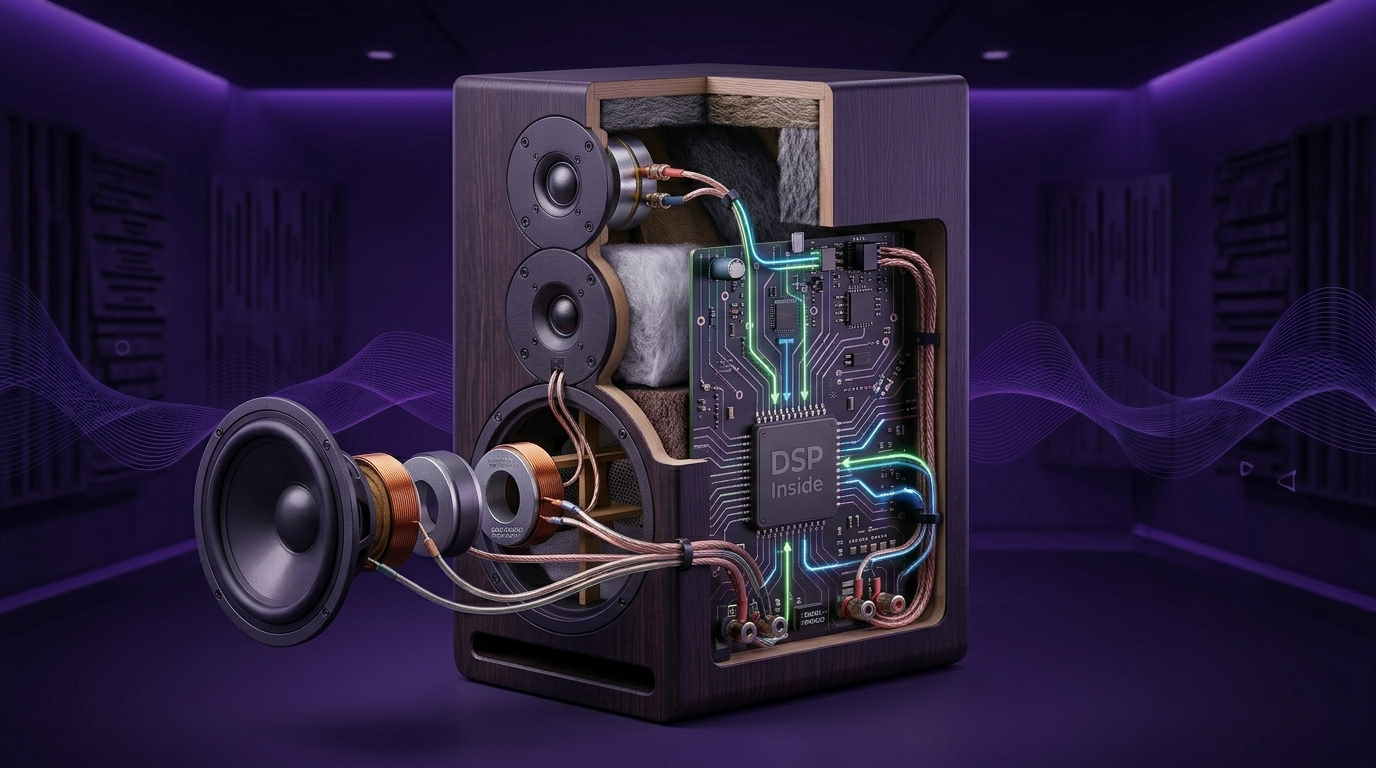
If you've ever wondered why a small Bluetooth speaker can sound surprisingly decent, or why studio monitors have that flat, accurate response - a big part of that answer is DSP inside of it.
Introduction
Before the digital audio came in, the speakers were simple analog devices. But analog has it's limitations. It has an uneven frequency response, a range it performs well in, and physical limits it can't exceed without breaking.
DSP (Digital Signal Processing) now takes place between your audio source and the amplifier, and its job is to bridge the gap between what the audio is and what the driver can physically do.
In this article we'll look at the main DSP techniques used in modern speakers - what they are and why they exist.
- A Signal's Path
- Equalization
- Crossovers
- Limiting and Protection
- Bass Enhancement
- Room Correction
- Time Alignment
- Summary
A Signal's Path
Before anything else, it helps to understand the path a signal takes:
Digital Source → DSP Processing → DAC → Amplifier → Speaker Driver → Listener
The DSP stage gets the audio in its digital form, applies all the corrections and processing, and then passes it to the analog chain. By the time the amplifier gets the signal, the work is already done.
Equalization: Flattening the Response
Every speaker driver has an uneven frequency response. Some frequencies come out louder than others just because of the physics of the space and our perception, as well the physics of the speaker design itself - the cone material, the enclosure shape, the port design. Without correction and fine tuning, you'd hear a colored version of everything you play.
Parametric EQ is the standard fix for this. The DSP applies a set of biquad filters across the spectrum — small second-order IIR filters that raise or lower specific frequency bands. Each filter has a center frequency, a gain amount, and a Q value controlling how wide or narrow the correction is.
H(z) = (b0 + b1*z⁻¹ + b2*z⁻²) / (1 + a1*z⁻¹ + a2*z⁻²)
That's the transfer function of a single biquad. In practice, a speaker DSP chains 8 to 16 of these together, each targeting a different part of the curve.
The goal here isn't to make the speaker "sound better" in a stylistic sense. It's to make it accurate — so the original recording comes through without the speaker adding its own color on top.
Studio monitors use this obsessively. The flat frequency response curve they advertise is mostly the DSP correcting a driver that wouldn't naturally measure flat at all.
Crossovers: Dividing the Work
Most speakers use more than one driver. A tweeter handles highs, a woofer handles lows, and sometimes there's a midrange in between. Each driver is built for a specific frequency range — send the wrong frequencies to the wrong driver and you either get distortion or get your speaker (or amp) damaged.
A crossover splits the audio into bands and routes each one to the correct driver.
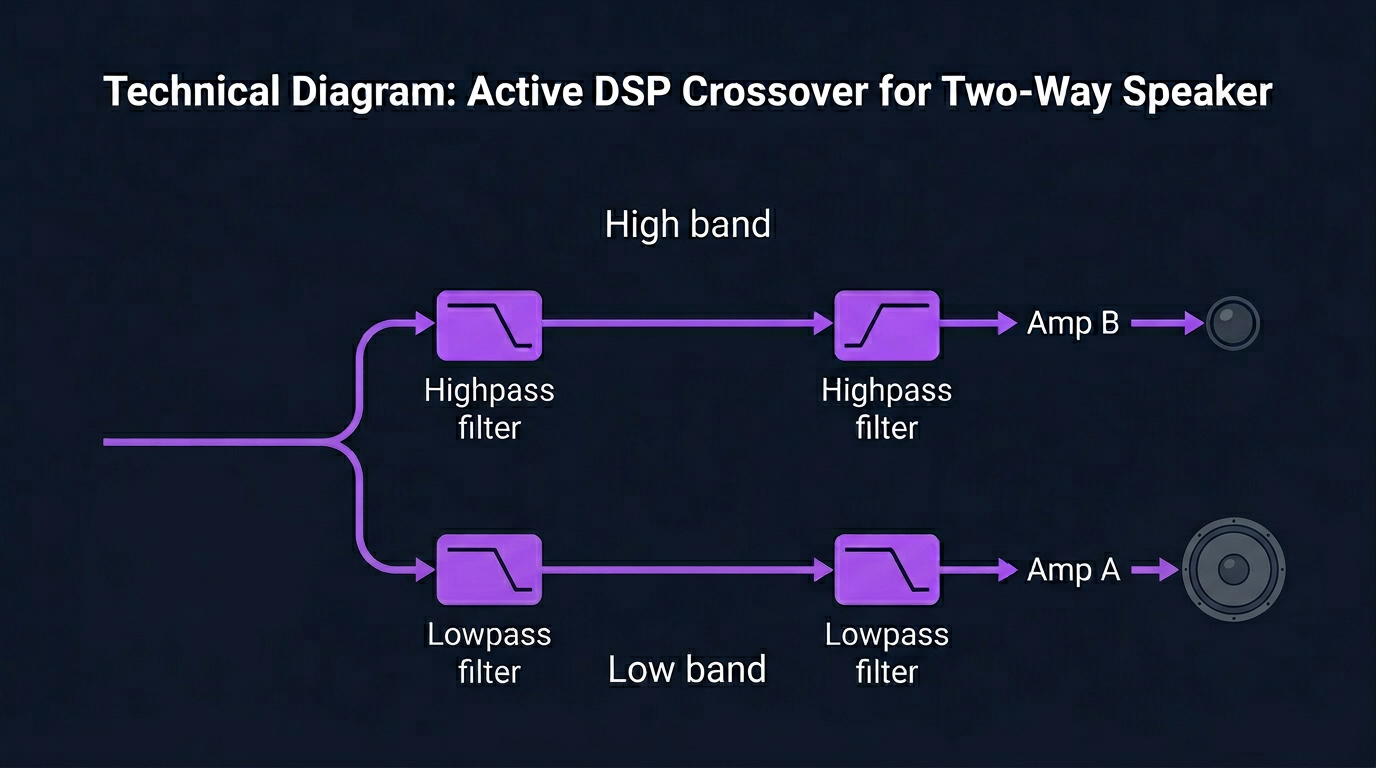
A passive crossover does this with physical capacitors and inductors after the amplifier. A DSP crossover (also called an active crossover) does it digitally before the amplifier:
Low band  → lowpass filter  → Amp A → Woofer
High band → highpass filter → Amp B → Tweeter
Some advantages of doing it in DSP are sharper filter slopes, independent amplification per driver, and no power wasted in passive components. But in reality it's just a lot more flexible - you can change the crossover frequency or filter shape in software without touching the hardware changing coils or capacitors.
The crossover frequency is typically somewhere between 2–5 kHz for a two-way speakers design, chosen so neither driver is pushed into a range where it starts to behave badly.
Limiting: Keeping the Driver Alive
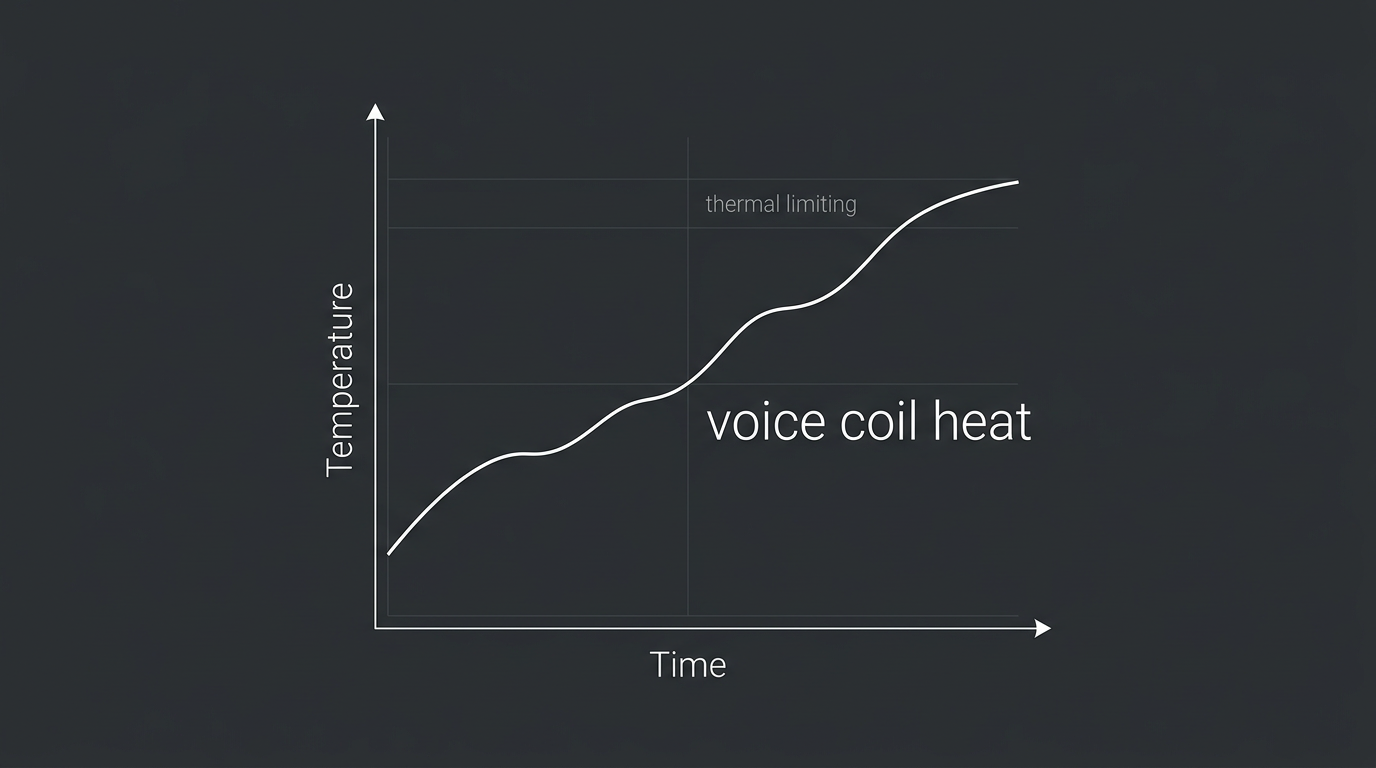
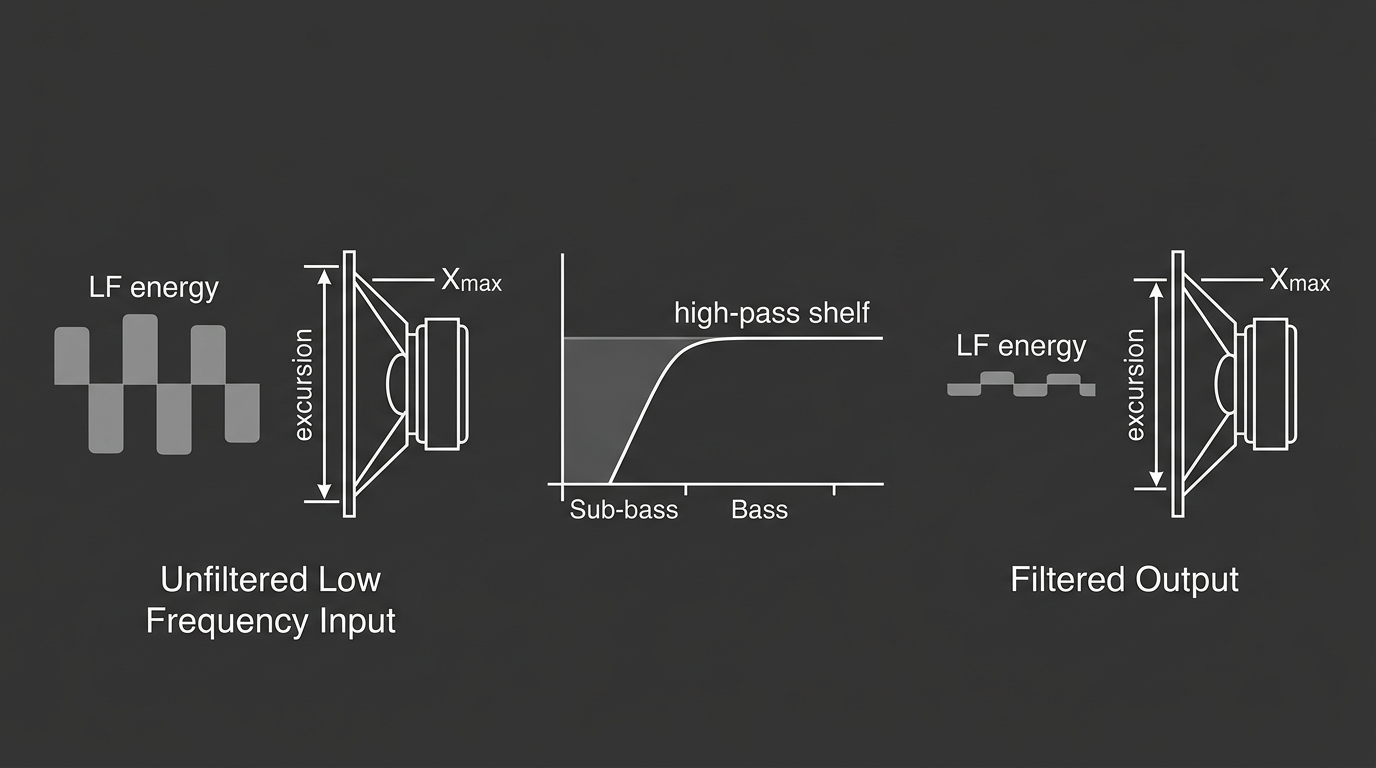
One of the less obvious but important DSP jobs is protection. Speaker drivers fail when asked to move too much — either thermally (the voice coil overheats) or mechanically (the cone exceeds its physical travel limit, called Xmax).
A limiter sits at the end of the DSP chain and checks the signal level. When the signal is heading into the red zone, it pulls back the gain before any damage can happen.
Modern speaker limiters usually track a few things at once:
- Thermal limiting — estimates how hot the voice coil is based on signal history, since heat accumulates over time rather than spiking instantly. It doesn't just respond to peak levels.
- Excursion limiting — watches low-frequency content specifically, since bass moves the cone the most. It applies a high-pass shelf at the very low end to keep the cone from bottoming out.
When a limiter is working correctly you won't notice it. The whole point is that it acts before the driver sends the sound out.
Bass Enhancement
Small speakers have a physical problem: the driver and enclosure are too small to produce deep bass naturally. Long wavelengths need either a large driver or a large cabinet to move enough air.
DSP can partially work around this in two ways:
Harmonic bass synthesis generates upper harmonics of the low frequencies the speaker can't physically reproduce. The ear naturally tries to reconstruct a fundamental tone from its harmonics, so you perceive the low note as present even though it technically isn't. It's a perceptual trick, and it works surprisingly well on music.
Parametric EQ bass boost applies a shelf or bell boost in the low end, combined with careful limiting to keep the driver safe. You get more perceived bass at the cost of pushing the driver harder — which is exactly why the limiter setup matters.
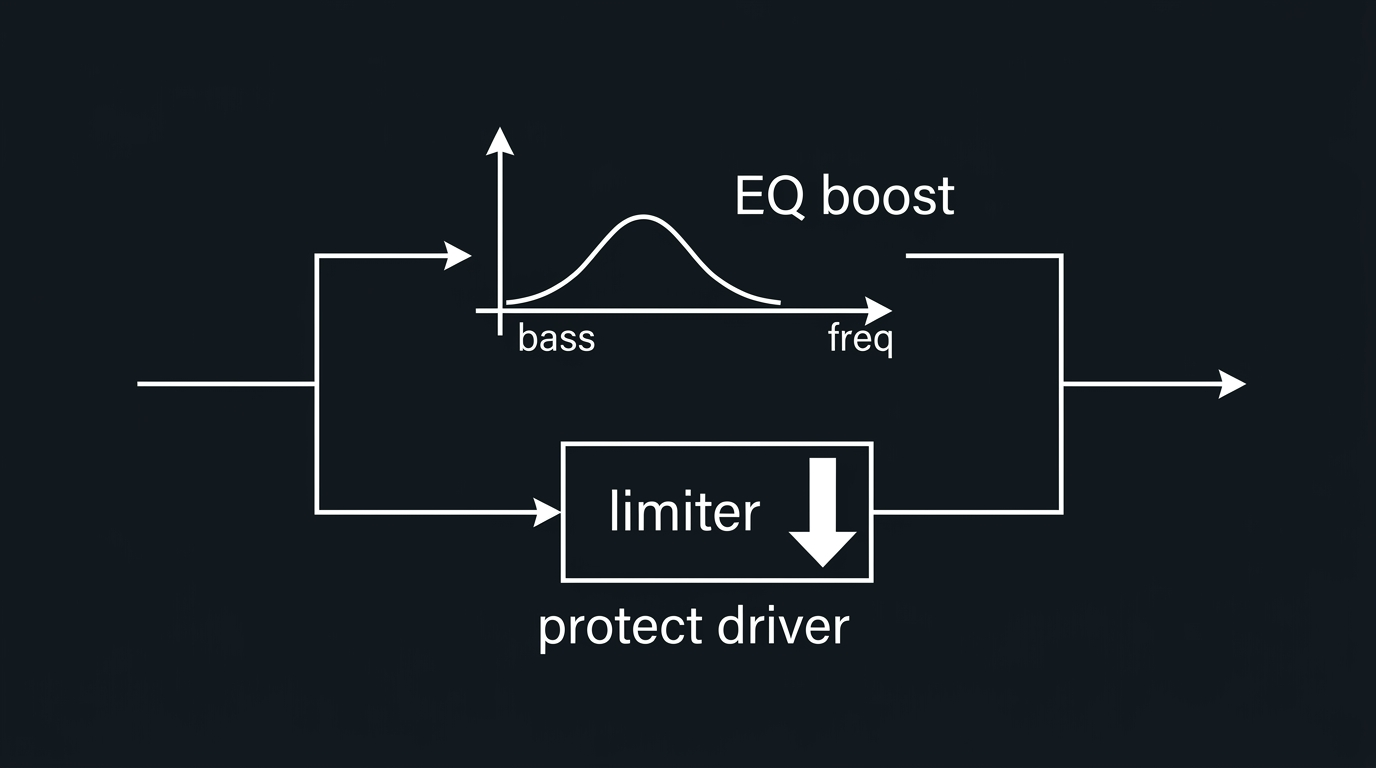
Most consumer Bluetooth speakers use a combination of both, which is why they can seem to produce more bass than their size suggests.
Room Correction
Even a perfectly calibrated speaker sounds different depending on where it is. Walls reflect sound, corners build up bass, and your listening position might be in a null where certain frequencies cancel. This is the room's own acoustic response coloring the playback.
Room correction DSP measures the acoustic response at the listening position and computes an inverse correction filter to cancel it out. It's the same principle as convolution reverb but in reverse — instead of adding a room's character, you're subtracting it.
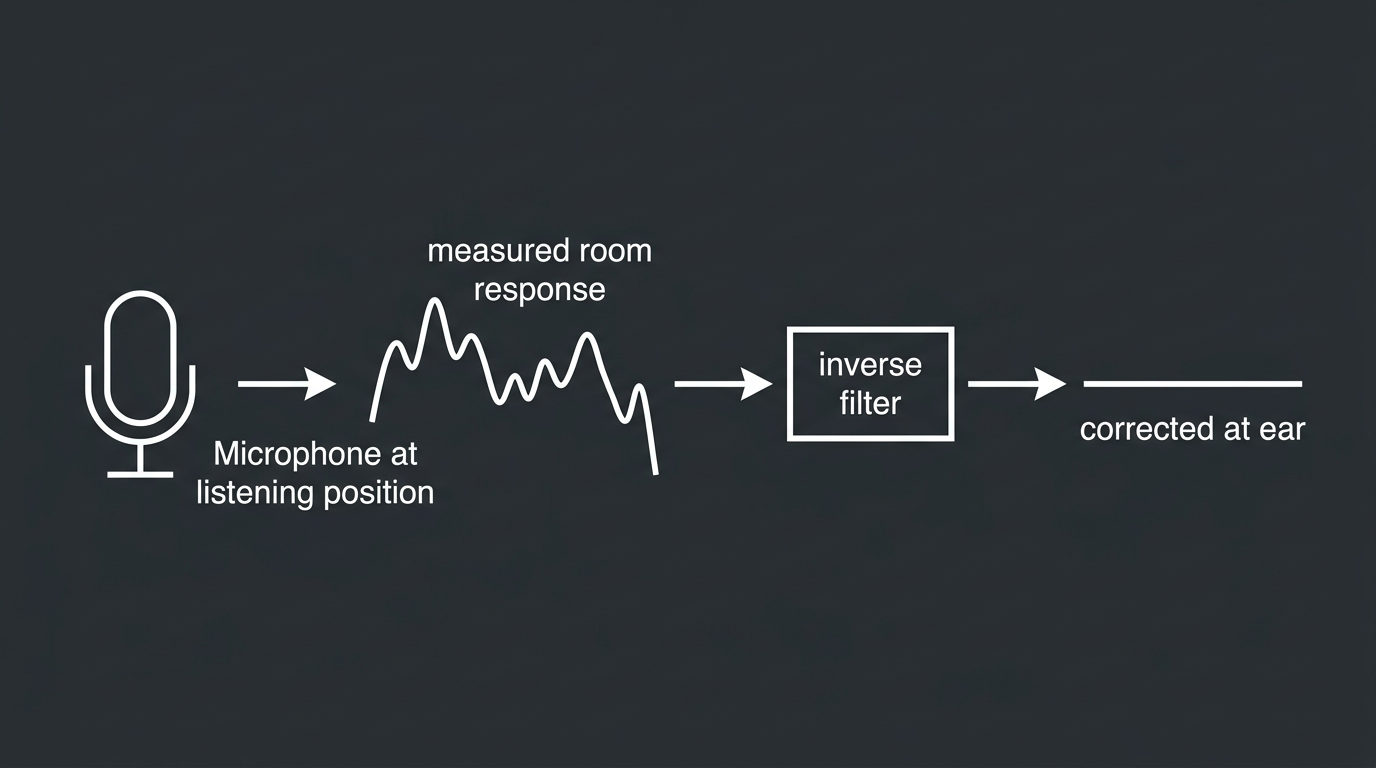
Higher-end systems like Dirac Live, or the DSP inside Sonos, HomePod, and many studio monitors do this automatically with a measurement microphone. Budget systems apply a fixed generic curve. Either way the math is the same.
This is actually a good example of how IR (impulse response) processing works in both directions — adding a room or removing one. Same concept, opposite goal.
Delay Alignment
In a two-way or three-way speaker, the drivers are physically at different depths — the tweeter is typically closer to you than the woofer. Sound from the tweeter reaches your ear a fraction of a millisecond before sound from the woofer. At the crossover frequency where both drivers are active at the same time, this timing offset causes phase issues where the waves partially cancel each other.
Time alignment delay adds a small digital delay to the tweeter's signal so both drivers arrive at your ear at the same time:
Delay (samples) = (physical_distance_difference / speed_of_sound) × sample_rate
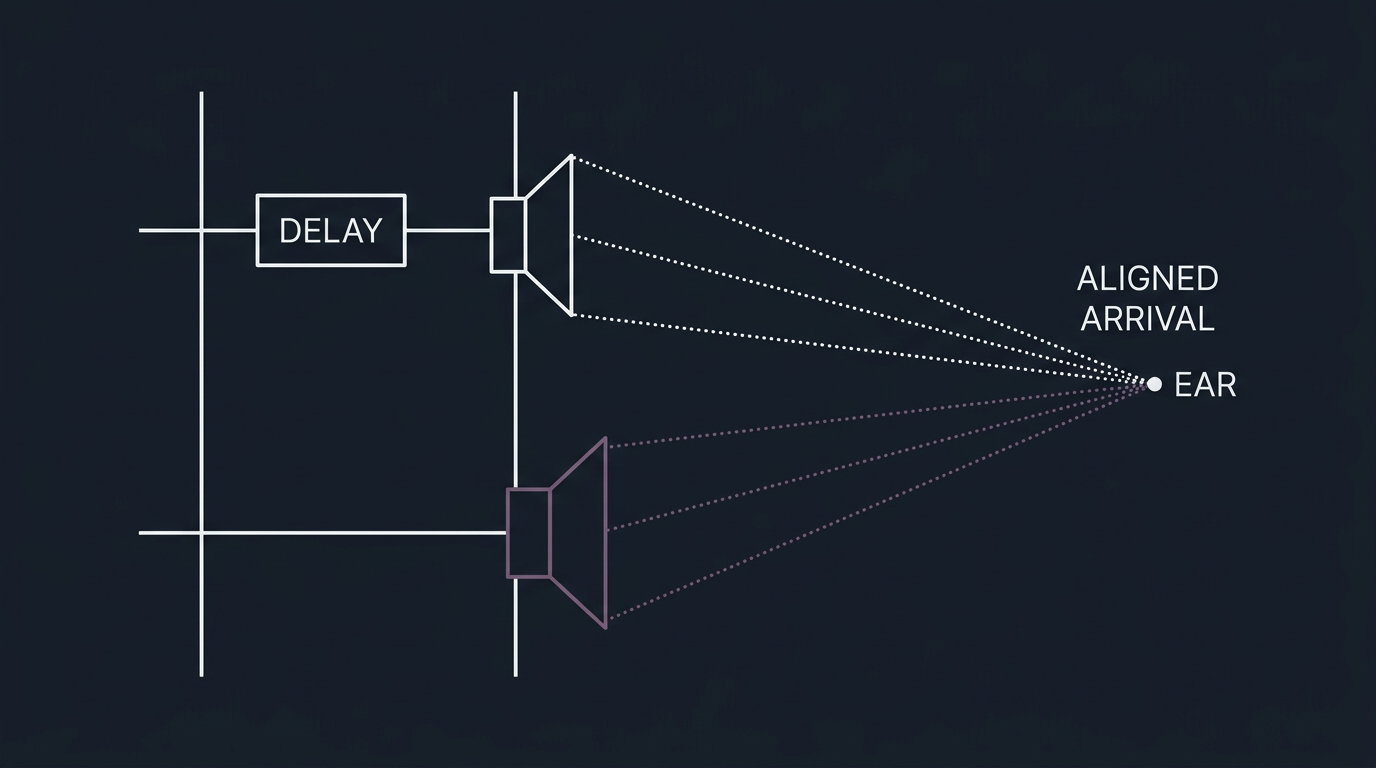
It's a straightforward calculation but it makes a real difference in stereo imaging and coherence around the crossover point. A lot of cheaper speaker designs skip this, and you can hear it.
Putting It All Together
In a real speaker DSP pipeline all of these run together on every buffer passing through:
Input
  → Input gain stage
  → Parametric EQ (driver correction)
  → Active crossover
  → Time alignment delay
  → Bass enhancement
  → Thermal + excursion limiting
  → Output to amplifier(s)
All of this happens at the sample rate — 48 kHz, 96 kHz — in real time, on hardware that might cost a few dollars.
Summary
DSP is the layer between what your audio source sends on the input and what the speaker physically do to produce it. Here's what it's handling:
- Parametric EQ corrects the driver's uneven frequency response using chains of biquad filters
- Active crossovers split and route frequency bands to the right drivers, more precisely than passive designs
- Limiters prevent damage by tracking both peak levels and thermal buildup in the voice coil
- Bass enhancement uses harmonic synthesis or shelved boosts to extend perceived low-end from small drivers
- Room correction measures and inverts the acoustic response of the listening space
- Time alignment delays drivers by fractions of a millisecond to compensate for their physical positions
All of this runs in real time on every buffer before the signal reaches the amplifier
Understanding what's going on inside a speaker makes it a lot clearer why two speakers with similar specs can sound completely different — the DSP implementation is often the actual difference.