- Authors

- Name
- Desi Ilieva
Previous Article
Next Article
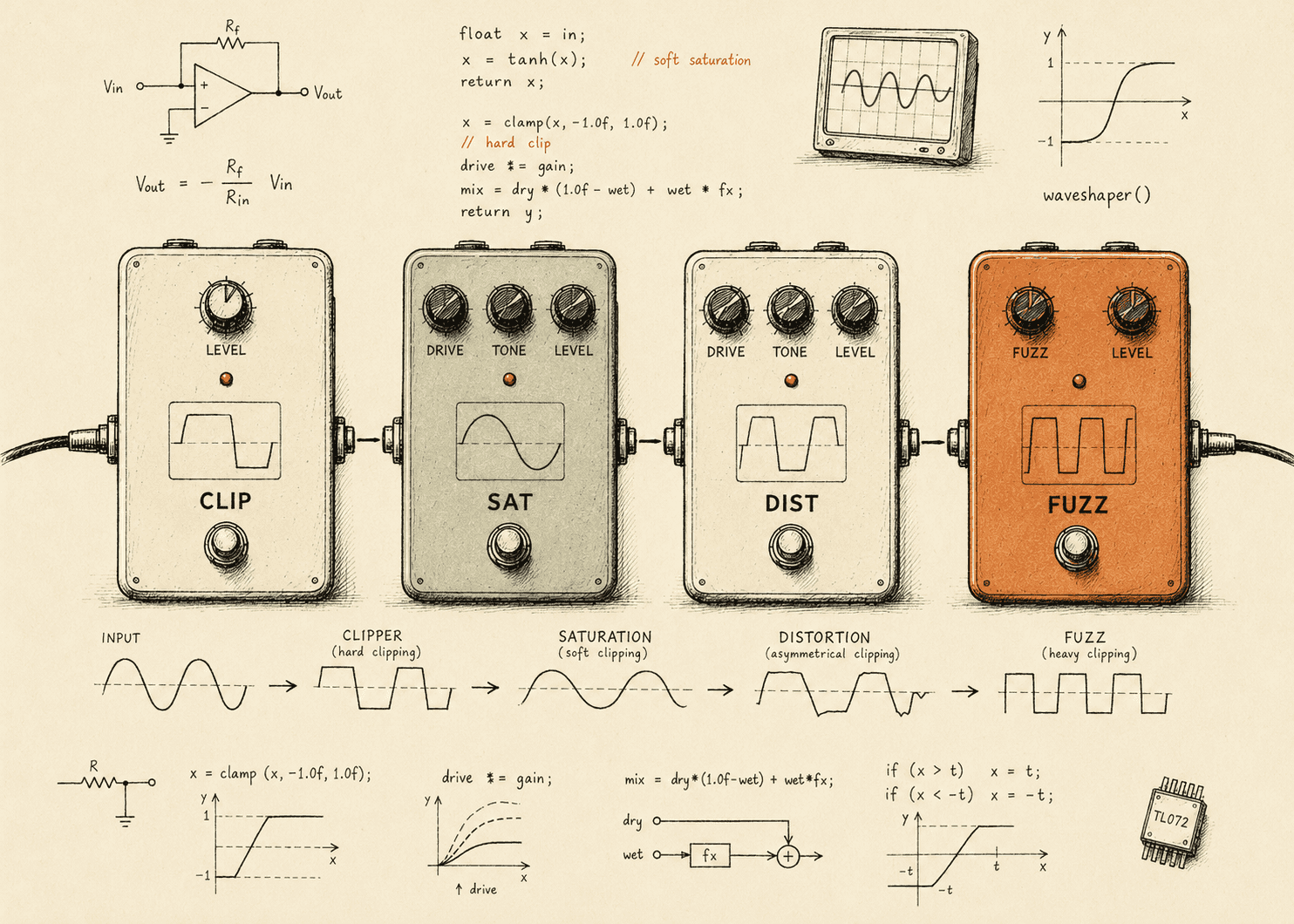
- All four of these are nonlinear processes — they reshape the waveform and introduce new harmonics. But the way each one clips, folds, or saturates is different, and that difference is exactly what gives each its character.
Introduction
Clipping, saturation, distortion, and fuzz are all forms of waveshaping. They all pass the signal through a nonlinear transfer function:
y[n] = f(x[n]);
Where f is some nonlinear function. When f is linear — just a constant multiplier — the output is a scaled version of the input. The moment the curve bends, clips, or saturates, new harmonics appear that weren't in the original signal.
The difference between these four comes down to how abruptly the function clips, which harmonics it produces, and how much of the original signal survives.
- What Are Harmonics and Why Do They Matter
- Hard Clipping
- Saturation
- High-Gain Distortion
- Fuzz
- Comparing the Four
- In Plugins and Code
- Summary
- FAQ
What Are Harmonics and Why Do They Matter
Before getting into each type, it helps to understand what these processes are actually doing to the spectrum.
When a sine wave passes through a nonlinear function, the output contains frequencies that weren't in the input — harmonics at integer multiples of the fundamental. A 440 Hz tone produces harmonics at 880, 1320, 1760 Hz and so on.
Two categories matter here:
- Even harmonics (2nd, 4th, 6th...) — sit at octave-related intervals. They often contribute to warmth and musical consonance.
- Odd harmonics (3rd, 5th, 7th...) — tend to add brightness and edge. Stronger odd harmonics are what make distorted guitars sound aggressive.
The ratio between even and odd harmonics, and how far up the harmonic series the energy reaches, is what determines whether a process sounds warm, gritty, or completely destroyed.
Hard Clipping
A hard clipper is the most basic nonlinear function. It passes the signal through unchanged until it hits a threshold — then it cuts everything above that threshold flat:
y[n] = threshold * sign(x[n])   if |x[n]| > threshold
y[n] = x[n]                     otherwise
The result on a sine wave: the rounded peaks get sliced flat. A sine wave with flat tops starts resembling a square wave. And a square wave contains only odd harmonics — 3rd, 5th, 7th — at amplitudes that decrease as 1/n.
This is where the hard edge comes from. Odd harmonics stacked together produce the crunchy, cutting character of hard clipping. It's the simplest and most predictable form of nonlinear processing, but also one of the most aggressive.
Note that a perfect symmetric clipper produces mostly odd harmonics. Real clipping circuits often have asymmetry, DC offset, or different positive/negative thresholds — which introduce even harmonics. The same principle applies across all these processors: symmetry → odd, asymmetry → even.
Hard clipping is used in guitar pedal circuits, digital overdrive algorithms, and as a building block inside more complex distortion designs.
Saturation
Saturation is a soft clip. Instead of a hard threshold that slices the waveform, the transfer curve rounds off gradually as the signal gets louder. The most common soft-clip function is tanh:
y[n] = tanh(drive * x[n]);
tanh approaches its limits asymptotically — it never hits a hard ceiling, it just gets closer and closer to it. The peaks of the waveform get compressed and rounded rather than chopped.
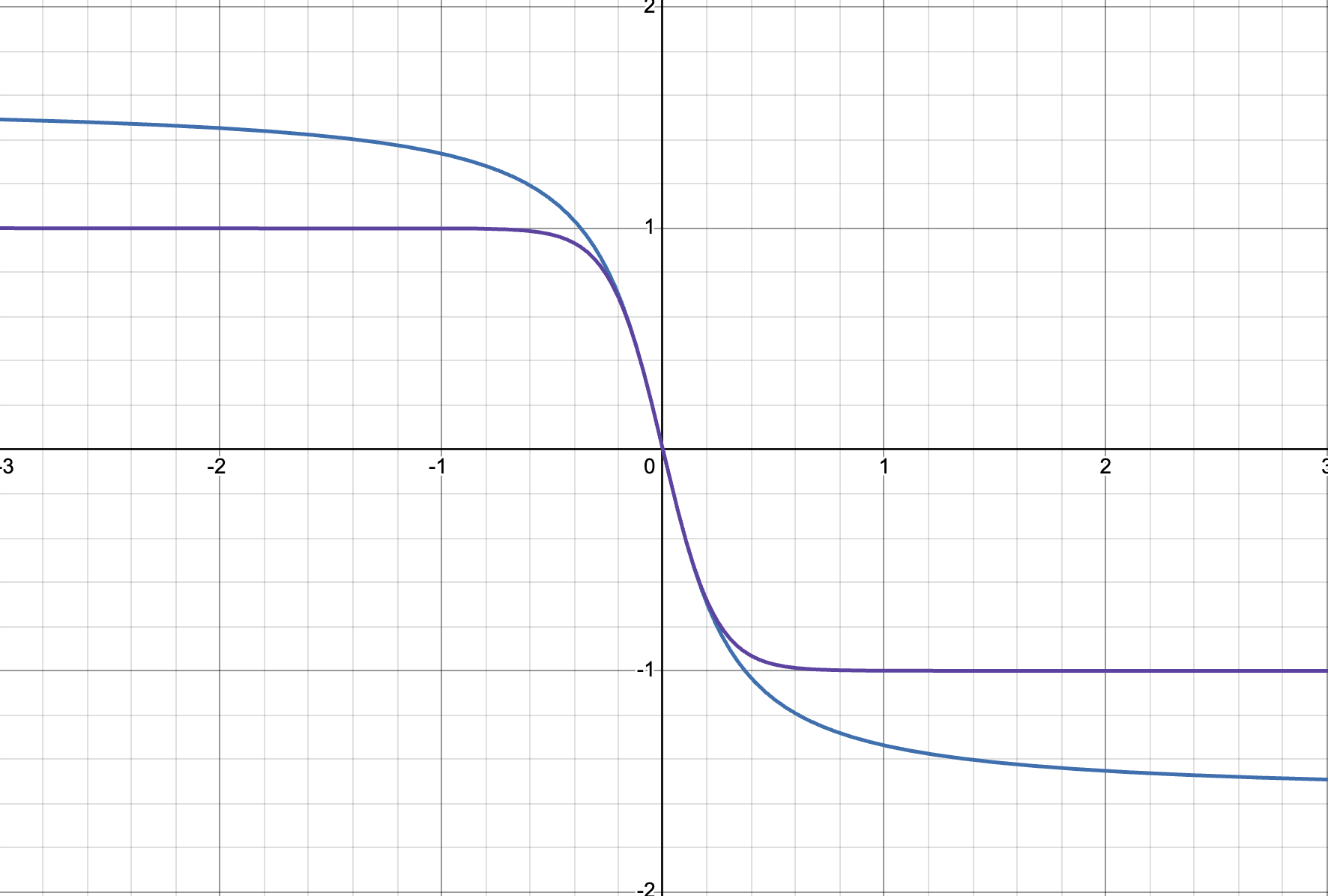
This rounding behaviour produces a smooth series of lower-order harmonics. Symmetric saturation functions like tanh or atan produce mostly odd harmonics, but many analog circuits introduce asymmetry — from tube bias, transformer hysteresis, or component mismatch — which adds even harmonics and contributes to their warm character.
At low drive amounts, saturation is subtle. You feel it more than hear it — the signal gets a little denser, transients are slightly compressed, things sit a bit thicker. At higher drive the rounding becomes more visible and the character more pronounced.
Besides generating harmonics, soft saturation also reduces dynamic range. Because the transfer curve gradually flattens, louder peaks are compressed more than quieter ones. This natural compression is one reason saturation can make sounds feel fuller even before the added harmonics become obvious.
Tape saturation, tube preamp drive, transformer saturation — these are all soft-clip behaviour, just with different curve shapes and frequency-dependent characteristics on top. Real analog saturation is also rarely memoryless — tape, transformers, and tubes all have frequency response, hysteresis, and dynamic behaviour that a simple tanh(x) doesn't capture.
- If you want to go deeper on transfer functions and waveshaping curves, check out Waveshapers vs. Wavefolders.
High-Gain Distortion
Distortion is technically an umbrella term that covers all of these — clipping, saturation, fuzz, and more. But when people say "distortion pedal" or "distortion plugin," they usually mean something specific: a high-gain clipping stage that sits between saturation and full fuzz.
This style of distortion clips harder and earlier than saturation. The curve still transitions gradually but it hits the ceiling much sooner and with a more abrupt knee.
Most guitar distortion pedals and drive plugins are essentially hard or near-hard clippers with tone shaping before and after the clipping stage — a pre-clip EQ to control which frequencies get pushed into the clip, and a post-clip filter to shape the result.
// pre-clip tone shaping
float shaped = toneFilter(x[n]);

// clipping stage
float clipped = hardClip(shaped * drive);

// post-clip tone and scaling
y[n] = outputFilter(clipped) * gainFactor;
This is also why output scaling matters after distortion — the clipping stage and new harmonics push the signal level up. Without scaling, the output clips the downstream chain. This is covered in Why scaling output after distortion is good?
Because distortion pushes harder into clipping than saturation, the dominant harmonic content shifts toward odd harmonics — that's the crunch and aggression. Some designs use asymmetric clipping, where the threshold is different on the positive and negative side of the waveform. Asymmetric clipping reintroduces some even harmonics back into the mix, which is part of what makes certain overdrive circuits sound less harsh and more organic than others.
Fuzz
Fuzz is the most extreme of the four. It doesn't just clip — it pushes the signal so hard that it approaches a square wave under heavy drive, regardless of input dynamics.
An extreme mathematical model of fuzz:
y[n] = sign(x[n]); // +1 or -1, nothing else
The sign function discards all amplitude information and outputs a square wave whose frequency follows the input but whose level is always the same. This is an idealized model — real fuzz is more complex — but it captures the core behaviour.
A square wave contains all odd harmonics all the way up the series — 3rd, 5th, 7th, 9th and beyond. The density of this harmonic stack is what produces fuzz's characteristic buzzy, almost synth-like texture. It's recognisably different from distortion even at similar perceived gain levels, because the harmonic content extends much further up the spectrum and the dynamics are largely gone.
Real fuzz pedals — Big Muff, Fuzz Face, Tone Bender — rarely produce an ideal square wave. They have bias shifts, asymmetry, filtering, and transistor compression that shape the output in more complex ways. The exact harmonic character varies with transistor type, supply voltage, and even temperature. This inconsistency is part of the reason fuzz pedals have such a distinct personality — no two behave exactly the same.
- Fuzz preserves pitch and timing, but almost nothing else. It's the most destructive of the four to the original signal.
Comparing the Four
| Clip Type | Dominant Harmonics | Amplitude Preserved | Character | |
|---|---|---|---|---|
| Hard Clipper | Hard threshold | Odd (3rd, 5th...) | Partial | Sharp, cutting |
| Saturation | Soft curve | Lower-order (varies w/ asymmetry) | High | Warm, dense |
| Distortion | Hard/near-hard + tone shaping | Odd-dominant | Medium | Crunchy, aggressive |
| Fuzz | Near square wave | All odd, very high order | Minimal | Buzzy, compressed |
The line between a hard clipper and distortion is mostly a matter of how much tone shaping surrounds the clip — the core clipping stage is often the same. The line between distortion and saturation is about how abruptly the curve meets the ceiling. Fuzz is genuinely distinct because of what it does to dynamics.
In Plugins and Code
When implementing these in a plugin or DSP context, all four are variations of the same structure:
// saturation
float saturate(float x, float drive) {
    return std::tanh(drive * x);
}

// hard clip
float hardClip(float x, float threshold) {
    return std::clamp(x, -threshold, threshold);
}

// fuzz (handle x=0 to avoid DC offset)
float fuzz(float x) {
    if (x > 0.0f) return 1.0f;
    if (x < 0.0f) return -1.0f;
    return 0.0f;
}
One thing all four share in the digital domain is an aliasing problem. Nonlinear processing generates harmonics that can exceed the Nyquist frequency and fold back into the audible range as aliasing artifacts. Hard clipping and fuzz are especially prone to aliasing because they generate harmonics that extend theoretically to infinity — every odd harmonic all the way up.
This is why oversampling exists — you run the nonlinear stage at a higher sample rate so the new harmonics have room above the audible ceiling, then downsample back. More on that in What is Anti-Alias/Anti-imaging filter?
Summary
All four reshape the waveform nonlinearly — y[n] = f(x[n]) — but the shape of f determines everything:
- Hard clipping cuts the signal flat at a threshold, produces odd harmonics, the simplest but most aggressive form of clipping
- Saturation uses a soft curve like
tanh, rounds peaks gradually, and compresses dynamics naturally — symmetric saturation produces odd harmonics, but analog asymmetry adds even harmonics that contribute to warmth - High-gain distortion clips harder and earlier than saturation, often with tone shaping around the clip stage, odd-harmonic dominant, crunchy
- Fuzz pushes past clipping toward square wave territory, destroys dynamics, produces a dense odd-harmonic stack all the way up the spectrum
- Even harmonics often sound warm and musical, odd harmonics tend toward brightness and aggression — the ratio between them defines the character
- All four generate aliasing in the digital domain — hard clipping and fuzz especially so — which is why oversampling is important for quality implementations
Frequently Asked Questions
Is saturation the same as distortion?
Saturation is a type of distortion. Distortion is the umbrella term for any nonlinear process that reshapes the waveform. Saturation specifically refers to soft clipping — gradual rounding of peaks rather than hard cutoffs. It's the gentlest form of distortion, often used for subtle warmth rather than aggressive crunch.
Is fuzz just extreme distortion?
In a sense, yes — fuzz is distortion pushed to the extreme. But it behaves differently enough that it's treated as its own category. Where distortion preserves some dynamics and waveform shape, fuzz approaches a square wave that destroys both. The result is a completely different texture: buzzy, compressed, almost synth-like.
Does clipping damage audio?
Unintentional clipping — like when a signal overloads your converters — introduces harsh artifacts that are usually unwanted. But intentional clipping through a clipper plugin or pedal is a creative tool. The "damage" is the point: you're reshaping the waveform to add harmonics and character. The key is doing it deliberately, with control over how hard the signal clips.
Should distortion plugins use oversampling?
For quality results, yes. Nonlinear processing generates harmonics that can exceed the Nyquist frequency and fold back as aliasing — audible as harsh, inharmonic artifacts. Oversampling runs the distortion at a higher sample rate so these harmonics have room above the audible range, then filters and downsamples back. Hard clipping and fuzz benefit most because they generate the most high-frequency harmonic content.